
A Child’s Performance
Bullet TrainThe Prince uses the appearance of innocence to influence adults, but the train’s experienced characters gradually learn to read the performance as a tactic.
increasing Bearing strength in each event
 decreasing
Bearing strength in each eventdecreasingAn Honours Student’s Mask

An Honours Student’s Mask
Calm conceals intent
When Kimura first meets Satoshi Oji, the boy appears polite, composed, and concerned for Wataru. His manners make him difficult to challenge, even as Kimura senses something sly beneath them.
The Prince understands how adults interpret children and uses that expectation to lower suspicion. The memory later makes Kimura’s current captivity feel like a continuation of an earlier misreading.
The Innocent Passenger
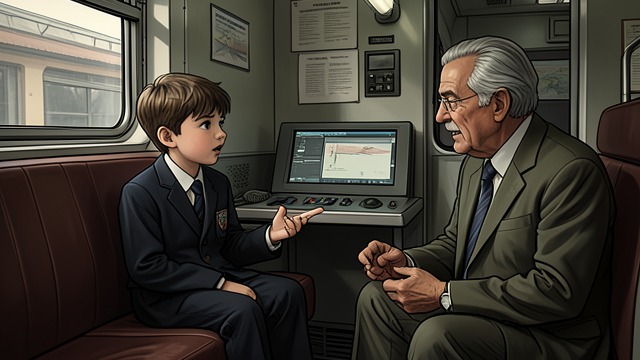
The Innocent Passenger
Performance as control
The Prince pretends to be a frightened child when speaking to Tangerine, and an agreeable student when speaking to Kimura’s father. He adjusts his tone to make adults protect him or distrust one another.
The performance is effective because it draws on real social habits. Adults hesitate to treat a child as a threat, even after evidence suggests that he can be dangerous.
The Mask Is Challenged

The Mask Is Challenged
Experience sees through charm
Shigeru rejects the Prince’s claim that he is merely an ordinary schoolboy. Akiko remains composed while the older couple question him about Yuichi and Wataru.
The Prince still tries to exploit their instinct to protect children, but they do not accept the performance as proof of innocence. Their skepticism turns his most reliable social advantage into a contested tactic.
At the first encounter with Kimura, months before the journey
During the train journey, after Kimura is bound
Near Morioka, when Shigeru and Akiko confront him
